





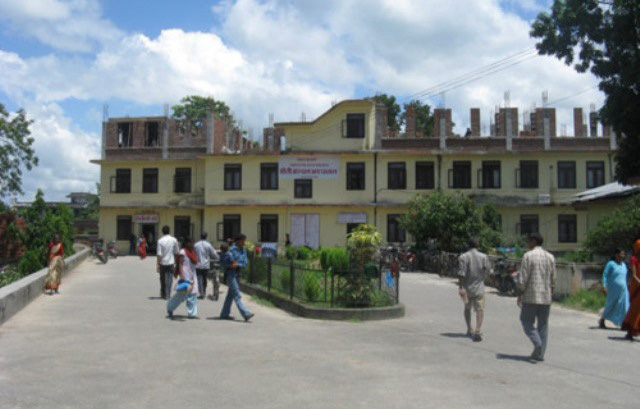
Seti Zonal Hospital gets dialysis machine
Bhaktapur, October 4
Health Minister Gagan Thapa today inaugurated the haemodialysis machine that was gifted to Seti Zonal Hospital by Bhaktapur-based Human Organ Transplant Centre, in Dhangadi.
The machine is the first of its kind in the far-western development region.
Health Minister Thapa expressed satisfaction at the expansion of services at the hospital and commended the contribution made by HOTC in the government’s effort to advance haemodialysis service across the country.
The dialysis unit has the capacity to provide dialysis service to as many as 24 kidney failure patients and also to provide 24 hours emergency service.
According to Dr Pukar Chandra Shrestha, executive director at HOTC, the number of kidney patients has been increasing in Bhaktapur and the centre is unable to provide timely dialysis service due to all.
He said, “People from different parts of country come to the centre for dialysis. Even patients from the neighbouring country India have registered for the service as it is cheaper here,” adding, “People have to wait for over two months to get the service due the huge influx of kidney patients. Longer waiting time, however, can be fatal for the patients.”
“The dialysis machine will be a huge relief for people from remote areas as they will be able to avail the service locally,” Dr Shrestha said.
HOTC is also planning to provide haemodialysis machines to Nepalgunj, Biratnagar and Surkhet districts. “We have spent nearly five million rupees on the machines,” said Dr Shrestha.
“The hospital has trained two nurses and a doctor for dialysis while staff doctors of HOTC Bhaktapur will also cover them for three months,” he informed.
Dr Shrestha added, “We mainly focused on the far-western development region because most of the people from these districts come to the capital for treatment.”
There are nearly 200 dialysis machines all over the country. Among them, nearly 150 machines are in hospitals inside Kathmandu valley, while the remaining are outside the valley.
Though the government provides kidney patients with Rs 200,000 for dialysis, the amount is not enough as patients from rural areas have to cover their cost for travel, food, hospital and shelter whenever they come to the capital for treatment.
Saroj Bhatta from Attariya of Kailali district was in Arogya Niketan Hospital to treat his father who is a kidney patient. He said, “It would’ve been easy for us if the dialysis machine was available in our own local hospitals. But we still feel relieved as the service has come to our hometown.” He said that his family had spent more than Rs 500,000 for his father’s treatment.
Similarly, Vishnu Babu Shrestha, 40, from Gorkha, a kidney patient, said people did not have to suffer if dialysis service was made available in all parts of the country.
“Medical expenses are extremely high for common people like us and the government needs to analyse these things while providing services.”
