





The life-pix connect
Lalitpur
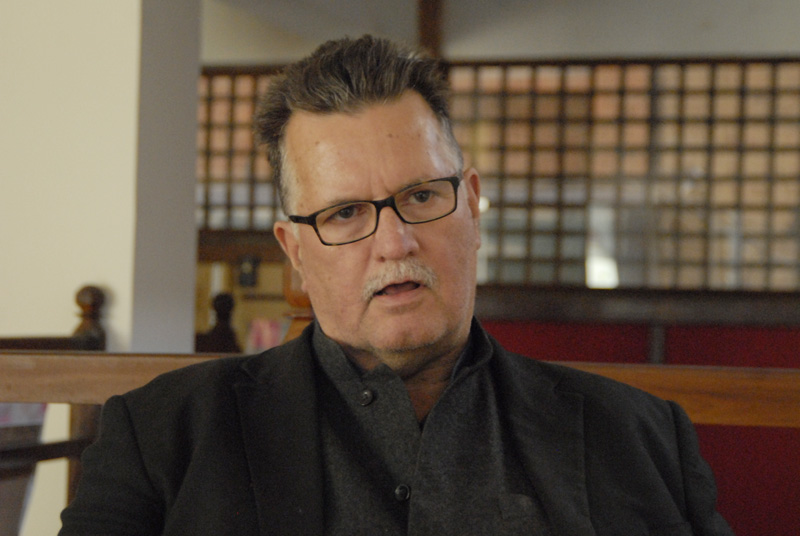
Prof Dr Christopher Pinney is an anthropologist and art historian from the UK whose researches are mostly based in central India and a place called Nagda Junction and nearby villages. He was in Nepal for Photo Kathmandu and this was his second visit to Kathmandu. He is currently the Professor of Anthropology and Visual Culture at University College, London. His research interests cover the art and visual culture of South Asia, with particular focus on the history of photography and chromolithography in India. Amongst his publications are Camera Indica (1997), Photos of the Gods (2004),The Coming of Photography in India (2008) and (together with the photographer Suresh Punjabi) Artisan Camera: Studio Photography from Central India (2013).
Thirty-two years of his research is focused in same village of India. Talking about how he got his destiny to work around the visual culture of central India, Prof Dr Pinney shared, “I first went to that place to do my PhD research ‘On Industrial Labour’ and then I fell in love with images, the villagers had there on walls and then found that the images were more interesting than industrial labour.”
With love for the images — even being trained as social anthropologist and his increasing interest in visual culture — his research shifted from industrial labour to image where he used anthropological approach to visual culture in that particular place. Talking about the source of inspiration to working with photographs, he explained, “It was a mixture of photographs especially ancestral photos, also printed religious images or calendar art. Mixture of seeing those on people’s walls and calendar image of Goddess Kali made me curious.”
He started to buy all kinds of images of Goddess Kali that he could get his hands on from the local shop. Then his destiny found him when one of the villagers saw a big roll of images of Kali in his room.
Prof Dr Pinney recalled, “He said I was acting in a foolish and dangerous manner because I was not worshipping the images of Goddess Kali every day. He went on to describe about the power of Goddess Kali and how she demanded worship. That was the moment when I realised an image has power, a life and force that needs to be properly engaged with.”
From here he never turned back. That led him to many years of investigating about the history of production of those images and also studying those images as an anthropologist — like what people did with those images, how they installed/worshipped/disposed and worked with them. He added, “The power and importance of image interested me. Those printed images were also called photos, so they occupied the same representational space as photography. Thus, I am still trying to locate photo in India, which made me doubly interested where photography seems to operate in this expanded field than it did in Europe or America. Over the years I worked on popular photography looking at the same town or village, studio practice, ancestral worship and image of popular culture in India. Tracing history as the major presence and exploring the contemporary uses of these images.”
Another reason he is still working with visual culture or photos of the same area is, “approach to photo has significantly changed over the years”. He stated, “I initially started engaging with photograph as a kind of window onto culture practices, understanding local central Indian practices. Early work tended to limit photography that shifted from how one thinks about photography, a technical practice globally distributed, in which study of one particular local practice can contribute to theoretical understanding of practices elsewhere. I then became interested in apparatus — the technology — of making photographs, how that is constantly evolving and what the consciences of that endless transformation are. This moved me away from thinking from more static view of photographic practice towards something that is more historically fluid, continuously evolving, getting smaller and faster where camera is replaced by cell phone.”
For Prof Dr Pinney, the fuel crisis was just the backdrop of the City as he was not having any difficulty while in Kathmandu. He finds the photo festival successful where he was surprised to see how people came to the event and started conversations. He shared, “If I have to compare this photo festival to the festivals held in others of the world, this is a successful one because it has made use of public historical places. My visit is limited but I enjoyed my visit, loved Kathmandu and I am seeing possibilities here in Nepal and that has made me excited and frustrated at the same time.”
