





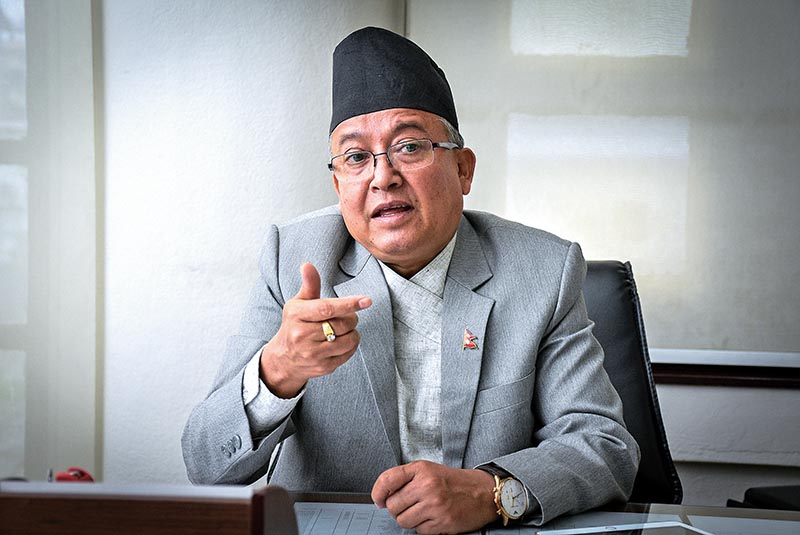
‘EC will be active throughout the year, not just around election time’
There’s considerable controversy surrounding the Election Commission and its work. There are allegations that EC office bearers have failed to stay above political influence. They are also criticised for lavish expenditure and misuse of public resources. The past general election revealed how expensive elections have become in Nepal, inviting strong calls for reforms. There’s also the issue of high percentage of invalid votes, raising questions about the EC’s voter training programme. Ram Kumar Kamat and Roshan S Nepal of The Himalayan Times caught up with Chief Election Commissioner Dinesh Kumar Thapaliya to talk about his priorities and plans for reforming the electoral system. Excerpts:
During your parliamentary hearing, you proposed a number of initiatives to strengthen the Election Commission and reform the electoral process. How will you execute those plans?
The Election Commission is an independent, autonomous body mandated by the constitution to conduct free and fair elections. Election does not only mean the period between announcement of election date and declaration of winners. The EC should always be active, not only during elections. The EC’s rights range from preparing voters’ roll to offering services related to elections to conducting elections as per the laws. In exercising these rights, we will be focusing on five or six key areas.
First, the EC is presently unitary and centralised. We have launched initiatives to decentralise the EC’s work and to revise its organisation by assigning all 753 local governments with election responsibilities. We will soon prepare a layout of the EC’s new organisational structure and forward it to the authorities concerned for decision. The EC will be restructured as per the country’s federal structure.
Second, we will prepare a strategic plan for steering the EC. We have formed a committee led by EC Commissioner Ishwori Poudel to prepare a strategic plan that focuses on five or six important areas. These include structural strengthening of the EC and promoting partnership with stakeholders such as media, political parties, voters and various government levels. Making use of information technology in elections, such as registration of voters’ roll and checking the status of registration, is another important area. We are focusing on using GIS and GPS technologies to monitor real-time status of around 10,000 polling centres across 753 local bodies. We are also focusing on strengthening the legal structure and building election infrastructure so that we can conduct elections on any given day. As far as legal structure is concerned, there are numerous scattered election-related laws that need to be unified. As for election infrastructure, we should aim for zero invalid votes. This can be ensured by robust voter education. So we need to make voter education regular and take it to the villages. Another important issue is election has become flashy and expensive. Good governance can be ensured only if the election is dignified, fair and economical. We plan to make sure a voter’s mind is not influenced by money or muscle, and for this, we will carry out reforms in the required areas through wider consultations. We also need to lower expenditure of public money by the EC or government during elections, besides the money spent by parties and candidates. Another important part is registration and management of political parties. We are very liberal while formulating laws, but are reluctant to abide by them. So let’s put in place laws and code of conduct we can adhere to. We will consult political parties regarding this.
The third area is conducting by-elections. There’s a vacant post in the House of Representatives, three vacant posts in provincial assemblies, and some vacant posts in municipalities and rural municipalities. There are some controversial provisions such as the government sets the dates for by-elections in local levels, and the EC sets dates for other by-elections in consultation with the government. We cannot afford to use all our energy in one by-election. We should complete all by-elections on an appropriate date. The EC will hold consultations in this regard. Although we’ve been getting assistance from various sectors for using IT during elections, we are still not sure about our present status in terms of IT uses. A report on how to make elections IT-friendly has recently been finalised. We will soon take the report with its recommendations to the implementation phase.
Another subject we plan to immediately execute is harmonisation of various identity cards that Nepali citizens have such as voter identity card, citizenship card, and national identity card. If we can link the voter identity card with the national identity card, we can avail all facilities through one card. We are also working on conducting voter education programmes in municipalities and rural municipalities. For this, the EC’s relations with political parties need to be strong because we need their support to inspire voters to vote independently.
So, we will list names of office bearers of all 753 local-level units of political parties to make it easier to conduct campaigns at local levels.
In a nutshell, the EC will be active all the year through, not just around election time.
Can you elaborate on plans to federate the EC’s work, and lower invalid votes?
A task force with representatives from the EC and other ministries has been formed to study what work to assign to which tier of the government. We will set up offices in all seven provinces and assign responsibilities to the provincial office concerned. A robust voter education programme is needed to lower invalid votes. This is not done only during elections, but also when there’s no election. We plan to sign MoUs with institutions that impart training so that they allocate certain hours to voter education in their curriculum. Voter education can also be included in school education. We need to design the course accordingly. We can also think about developing university programmes specialising in elections. We can also use IT for voter education through social media, other media, and smart-phone applications.
You said you’re preparing for by-elections. Do you have a timeline?
The vacant posts include HoR member from Kaski Constituency No 2; Provincial Assembly members of Baglung, Bhaktapur and Dang; Dharan Municipality mayor; chairperson of Pipara, Falgunanda and Makalu; and the rest are ward chairs. There are around 940 vacant posts, but we are not mandated to conduct by-elections for posts lower than ward chairperson. Many posts are vacant because people or parties did not field candidates. For example, nobody filed candidacy for a certain seat reserved for Dalit. We are very aware of this issue. We will soon announce a date.
The EC says it should be allowed to set election dates as it is an autonomous body. What’s your take?
I believe political parties are more committed to elections than the commission. The Parliament and the government are also equally committed. My view is we can include the month for election in the law. Let’s not enter the exact date, but a month for election — local, provincial and federal — can be included in the law, with the exception of mid-term elections. In the amendment to the Act, the EC will make such a proposal.
It is alleged the EC has not been able to strictly enforce the election code of conduct. What do you say?
We don’t abide by the code of conduct, but we expect others to comply with it. This is a matter of self-discipline. My understanding is the EC is not a body that takes action against those violating the code. The EC wants to create a situation where no finger is pointed at anybody. This is possible if we become impartial, self-disciplined and self-controlled. For example, we get complaints seeking action against a certain party for not conducting general convention. So if we establish a system whereby parties themselves announce their status such as the number of female office bearers or plans for general convention, such a situation will not arise. I will make efforts to change the system, but this does not mean I will drag my feet if I need to take action.
The Supreme Court has issued a directive order to the government regarding external voting rights of Nepalis living abroad. Does this fall under your priority?
Yes, eligible Nepali voters have not been able to exercise their rights because they are not in Nepal. The SC has issued a directive in this regard. The EC strongly believes the utility of democracy is participation of all voters, including those living abroad. But how to ensure that is a serious issue. Our electoral system is a mixed system of first-past-the-post and proportional representation. Also, elections are conducted at various levels, from federal and provincial to local and ward levels. So, to what extent can external voting be carried out should be studied. For example, a person from Ward No 1 of a certain rural municipality is living in Japan. The question is, which among all these elections should that person participate in from Japan. Also, if we set up a polling station, say, in our embassy in Washington DC in the US, people should take up to 5-6 hours flight to reach there from within the US. We need to study all these aspects, hold consultations and come up with alternatives as mandated.
Election commissioners have faced allegation that they can never be free of political influence. Even in your case, it is said that you are a strong supporter of the then CPN-UML. What do you say?
Lately, there’s a tendency to describe every individual as sympathiser of a certain party, ignoring that person’s qualification and calibre. This has polarised society. All the constitutional bodies have their own respect and dignity. If an office bearer is not able to uphold that dignity, how will that person face society? It is not that I am going to die right after conducting the next election. I want to live until I die with dignity and respect even after retiring from the EC. Also, if we start describing persons appointed by the Constitutional Council as cadres of a certain party, all elections conducted in the past should be nullified. In my case, I will always uphold the image and dignity of the EC, and make sure elections are accepted by all. Also, there are winners and losers in election. If losers allege partiality, this cannot give a solution. For me, it does not matter who wins or loses, but I will make sure the EC never loses. The EC cannot alone be impartial. It can be impartial only if all, including the media, civil society, election officials, observers and security forces, are impartial.
Questions are being raised by many, including the Office of the Auditor General, about the EC’s expenditure. There were reports of the EC purchasing unwanted vehicles and office bearers misusing them. How do you plan to address this issue?
My plan is to rectify past mistakes and avoid mistakes in future. I have directed authorities concerned to address questions raised by the OAG. The process of settling irregularities will begin soon. Our efforts will be to ensure zero arrears.
As for questions related to EC office bearers using office vehicles for personal purposes or purchasing unnecessary vehicles, I did not find any office bearer doing this when I joined the EC. If it was the case in the past, we need to understand that some special circumstances during election might have prompted office bearers to take such decisions. I plan to coordinate with the home ministry and other ministries to hand over unnecessary vehicles with the EC to wherever needed. We also have a press and printing equipment, among others, that are used only during election. I will consult whether we can outsource such services.
