








Collaboration is the answer
There are really no limits to what can be accomplished if we dream together
KATHMANDU
I recently made a trip to Rasuwa to observe work at the Community Self Reliance Centre (CSRC) and to see how people were getting along four months after the April earthquake. I saw a number of people still living in tents and rubble that needs to be cleared but life seemed to be somewhat returning to (a new) ‘normal’. As relief efforts are beginning to end and the government, INGOs/NGOs move towards recovery efforts through livelihood development, hopefully it is possible to ‘build back better’.
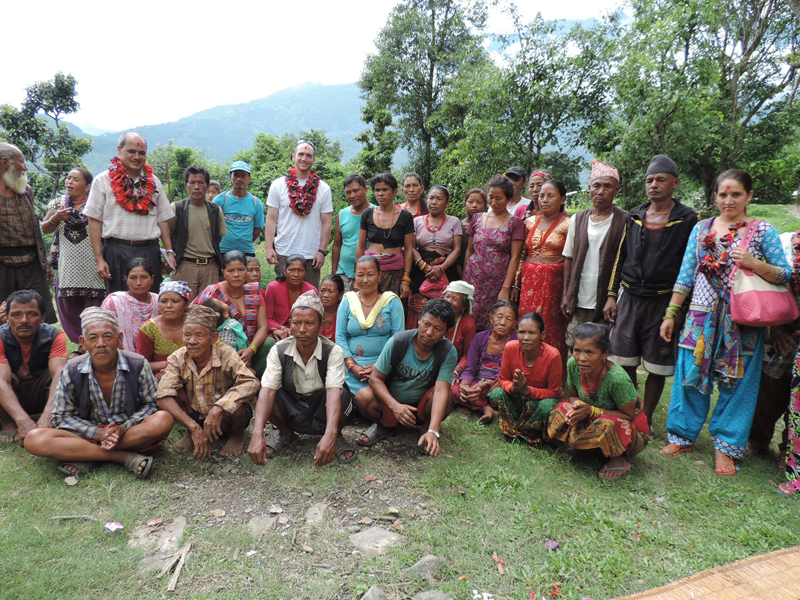
In one community meeting hosted by Community Self- Reliance Centre (CSRC), a project framework was laid out in which, based on a household, family centered, business first approach, those most vulnerable would be provided with training, inputs, mentoring and access to markets in order to improve their household incomes. (Other parts of the project include Disaster Risk Reduction (DRR) community training and access to Improved Cook Stoves (ICS) in order to reduce women’s time collecting firewood and to improve family health).
It was explained that CSRC wanted to help people earn enough in order to rebuild their homes within five years. This meant that based on a new home cost of approximately, for example, Rs 500,000, they would need to save about Rs 8,333 per month. For many people this probably meant doubling what they were making on a monthly basis prior to the earthquake. Since many of the project beneficiaries are landless or small land holders, this makes the situation all the more challenging as owning even a small parcel has implications for household income and self-recovery.
The key though is collaborating, being creative, going beyond boundaries and letting go of organisational ego
As observed in another meeting with a variety of NGOs, Rasuwa has a lot of resources. Due to any natural disaster, in this case the earthquake, there are more resources available in a country, which if focused properly can really make a difference in people’s lives. The key though is collaborating, being creative, going beyond boundaries and letting go of organisational ego, resulting in maximum benefit for those most vulnerable.
Collaborating avoids duplication and enables organisations to stretch their resources. Examples of this, as noted in the NGO meeting, includes an organisation which provides specific agricultural or animal husbandry training, but does not provide inputs, as well as the reverse. There were many opportunities to partner in which one organisation could provide inputs and the other could provide training. Another example was of an organisation providing only inputs, for example, seeds for personal household consumption but now thinking further on how to move into limited commercial production. This is accomplished through partnering.
There are also many other examples of areas for partnering and developing holistic approaches to enable farmers to be successful including adding small irrigation systems, tunnels, upgrading collection centres and establishing cooperatives. Bringing together a variety of expertise results in the ultimate beneficiaries seamlessly obtaining a comprehensive package to more expertly grow/produce leading to greater household incomes and an opportunity to rebuild better, for example, an earthquake resistant house, better education for children, greater access to health care and options for a better quality of life.
For an organisation in order to continue fundraising it needs to ‘toot its own horn’. But there are ways to do this. One is partnership which takes longer and a tremendous amount of communication and strong will. However, if we keep in mind who we are trying to help, this makes perfect sense.
After listening to everyone in the NGO meeting I suggested that through partnership, Rasuwa could become a model district in showing how collaboration could make a huge difference in the lives of people. I am convinced that we do know all of the answers. However, if we do not, based on Nepali ingenuity and the help from a number of people and organisations who truly care about Nepal, the answers can be found.
There are really no limits to what can be accomplished if we can dream together, put aside our egos and believe in the goodness of humanity.
The author is a freelance journalist writing about issues in Nepal. He can be reached at mikerlakers@yahoo.com
