








Planetary trio of Mercury, Jupiter, Saturn for grand evening around Jan 10
KATHMANDU: The astronomical calendar for 2021 is beginning with a splendid planetary triad of Mercury, Jupiter and Saturn- weeks after the great conjunction of the two biggest planets in our solar system.
Jupiter and Saturn were as close as they could get on December 21, only a few weeks ago. Although the two planets are still relatively close, Saturn is now moving farther away from Jupiter with passing time.
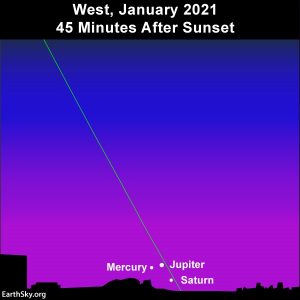
Before they disappear from our view in the earth sky, Mercury will join Jupiter and Saturn to make a special triad on January 9, 10 and 11.
Jupiter and Saturn are following the sun these days and appear lower in the horizon each evening. They are visible only after sun is below the horizon, about 30 to 45 minutes after sunset, and about one and half hour before sunset.
As the two climb down each evening, Mercury, in contrast, will climb upwards. It will pass Saturn first for a conjunction on Jan 9 and then Jupiter on January 11. The three will get the closest on Jan 10.

On Jan 9, Mercury will pass 1.67 degrees south of Saturn. On Jan 10, the three fit tightly inside 2.5 degree circle (making quite a triangle). On Jan 11, Mercury will pass 1.5 degrees south of Jupiter.
Since the event would not last for long, sky-gazers must be precise to see them meet towards the direction where sun has gone down near the horizon.
According to earthsky.org, Jupiter is about 2.5 times brighter than Mercury, and 10 times brighter than Saturn. This makes Mercury about four times brighter than Saturn.
In case you are thinking what other planets are doing at the time of the event- Mars would also be visible in the sky as the only bright (red) planet in the sky appearing all night. Meanwhile, Venus, the sole morning planet, appears each morning before sunrise and fades away as sun dims its presence.
Also, there is a planetary trio of Mercury, Venus and Jupiter coming up in February, in the morning sky.
Compiled by Kriti Joshi
