








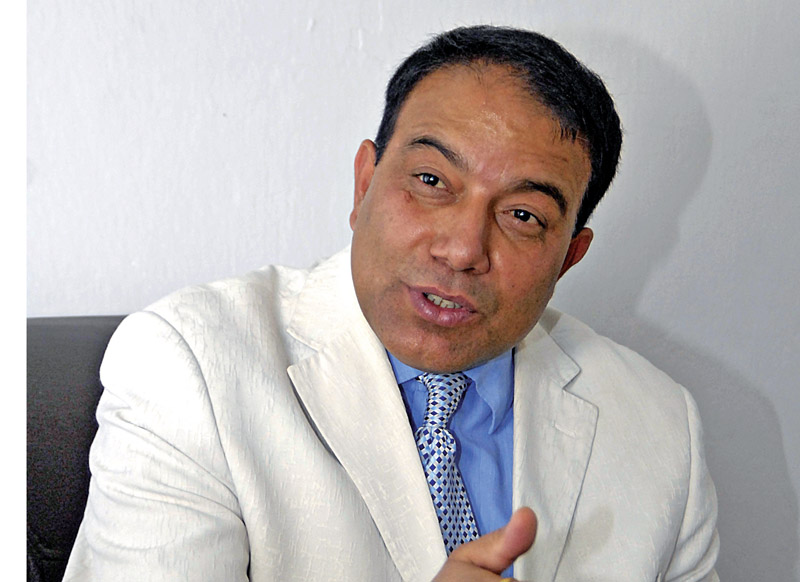
We are confident about completing reconstruction works in five years’
It has been almost a year since the devastating 7.8-magnitude earthquake struck the country on April 25, 2015. The tremor, which was followed by two major aftershocks of 6.8 magnitude on April 26 and 7.3 magnitude on May 12, caused heavy
destruction in 14 districts, including three in Kathmandu Valley. The quakes also claimed around 9,000 lives, completely destroyed over 500,000 private houses, affected livelihoods of about 5.6 million workers and caused damage and losses worth around Rs 706.46 billion. The damage was colossal. Yet, the government has failed to expedite reconstruction and rehabilitation works, forcing quake survivors to live in makeshift shelters and rendering students in temporary learning shelters. Rupak D Sharma of The Himalayan Times caught up with Sushil Gyewali, CEO of the National Reconstruction Authority, to discuss problems delaying implementation of reconstruction and rehabilitation works.
There are complaints that reconstruction and rehabilitation works are moving ahead slowly. Even Prime Minister KP Sharma Oli recently lashed out for the delay. What do you have to say?
The claim that reconstruction works are moving ahead slowly is not baseless. But what should also be taken into
account is the delay in formation of the National Reconstruction Authority (NRA) due to various reasons. But since the
establishment of the NRA around three months ago, we have been successful in laying the groundwork to execute various tasks related to reconstruction. For instance, we have already developed organisational structure and framed legal framework and guidelines to implement reconstruction works. Also, we have rapidly conducted survey of private
houses destroyed by quakes as per commitment expressed to donor agencies. To conduct these surveys, we have mobilised over 1,600 engineers and have completed around 90 per cent of the work in 11 districts. So, reconstruction works have been moving ahead rapidly since NRA’s establishment.
At places where surveys have completed, the NRA has started signing agreements with households to extend first instalment of grant. But grant distribution process has not begun in many places. What is causing the delay?
As you know, we just distributed first instalment of grant of Rs 50,000 in Singati of Dolakha district through the banking channel. With this, we have commenced grant distribution process. But this was also an experimental phase, during which we observed how different systems, including IT, responded. During this phase, we also encountered problems but we also learnt how to tackle them effectively. So, the first phase of grant distribution process should be considered as a pilot phase during which we identified shortcomings of our system. This will help us to make our system robust and avoid repetition of similar mistakes in other places where we will soon be distributing grants. At present, there are still a few technical issues that need to be sorted out. Once we deal with them, we will start distributing the grant in other places as well.
But the delay that is being made has forced people to stay in temporary shelters, isn’t it?
In order to distribute grants, we first have to complete survey of private houses destroyed by quakes. Based on these surveys, we create lists of beneficiaries. This means grant distribution process begins only after full list of beneficiaries is prepared. I have just been informed that surveys have been completed in over 200 VDCs. So, by April 24, we will initiate the process of signing agreements with a large number of households. We will then start distributing grant and rebuilding houses.
The NRA has said first instalment of Rs 50,000 should be used to lay foundation of houses. Based on the progress, the NRA will extend second and final instalments of Rs 80,000 and Rs 700,000, respectively. But many say this money is not enough to build quake-resilient houses. What is your take on this?
The first instalment of Rs 50,000 is being extended to build the foundation and plinth of houses. If the foundation and plinth that have been built meet our standard, we will release the second instalment of Rs 80,000. I would like to mention that the grant is being extended to build safer and better houses. This implies houses being rebuilt should ensure safety of dwellers during times of disasters. In this regard, the government will organise orientation classes to transfer technical skills required to build safer and better houses. We will also monitor the progress based on which other instalments would be released.
So, you think the grant amount of Rs 200,000 is enough to build a quake-resilient house?
Yes, it is enough to build an ordinary but safe house — albeit it may not be sufficient to build bigger houses. But what one should understand is that the state is extending the grant to express solidarity with people during times of trouble. What also needs to be understood is that the grant we are extending is taxpayers’ money, so the government has to be careful about not squandering resources. In this regard, we have asked home owners to use construction materials recovered from the debris and contribute their labour while building houses. If they do this, Rs 200,000 would be enough to purchase construction materials and cover wages of construction workers.
Since the grant amount is being distributed in different places at almost the same time, demand of some of theconstruction materials are expected to go up. If this demand is not met by supply, prices of construction
materials will rise, resulting in cost overrun. How are you planning to tackle this problem?
Yes, we might encounter this problem. That’s why we have held discussions with local traders as well as producers; and they have expressed commitment to ensure adequate supply of construction materials. If the supply chain works efficiently, the market will not face short-supply of goods. To ensure proper functioning of the supply chain, we have to conduct market monitoring activities on a regular basis. In this regard, committees formed under chief district officers will observe the supply situation and intervene if there is any problem.
Recently, the NRA had said absence of VDC secretaries had delayed the process of signing grant agreements with quake survivors whose houses were destroyed. Has the process of hiring these staff begun?
The Ministry of General Administration has already initiated the process of hiring VDC secretaries, and the Ministry of Federal Affairs and Local Development is facilitating in this matter. So, we expect the government to recruit VDC secretaries soon because without them agreements cannot be signed.
It is also said many line ministries and other government agencies are not extending adequate cooperation to the NRA, which is delaying implementation of many works. Is it true?
No, that is not completely true. What one should understand is that post-earthquake reconstruction work is new for the country as well as the government. Also, the concept of the NRA is novel in itself. So, the bureaucratic system needs some time to get used to this new concept. Also, government officials do not want to undertake very challenging jobs. As we’ve seen in the past, government officials generally express reluctance to work in very remote and rural areas. To encourage such officials, the government has offered incentives as well. At the NRA, officials have to work under tremendous pressure because people are expecting a lot from us. So, many officials may have expressed lack of enthusiasm to join the NRA. But this should not mean they are not extending cooperation. Also, we need technical experts, which our bureaucratic system lacks. But things are gradually improving, as we have hired adequate staff for our secretariat in Kathmandu. We have also initiated the process of hiring employees for sub-regional offices. In case, we fail to recruit adequate staff for sub-regional offices, the NRA Regulation has paved the way for us to hire employees on contract basis.
The NRA had earlier floated the concept of establishing seven sub-regional offices. But so far only one such office has been set up in Dolakha district. Is this delay due to shortage of staff?
We have already initiated the process of setting up sub-regional offices in Gorkha and Nuwakot. In fact, staff have already been transferred to those places. But we still have not found office space in those districts. Once we find the space, all seven sub-regional offices will come into operation. Also, we have decided to set up a special office under sub-regional office in Sindhupalchowk, considering huge losses — both human and physical — suffered by the district.
The NRA had also floated the idea of building model houses in at least five districts. What’s the update on that front?
We are planning to initiate the process of building those houses within April 24. Development of such model houses will give others in the locality an idea on how to build safe houses. We will also run orientation classes at villages to teach people ways to build safer and better houses.
But this work should be tied up with grant distribution process, isn’t it? Otherwise, people who have received first instalment of grant may start building houses haphazardly.
We have just distributed grant amount in Singati of Dolakha. We will soon extend technical support there by mobilising engineers and overseers. These technical experts will transfer knowledge on ways to build safer and better houses. In this regard, the Ministry of Urban Development has started the process of hiring around 2,700 engineers, overseers and sub-overseers. These technical experts will be sent to every village damaged by quakes. So, the NRA is laying a strong foundation to rebuild parts of the country devastated by quakes.
But the NRA still hasn’t been able to perform one major task, which is framing the Post Disaster Recovery Framework (PDRF), which will guide reconstruction and rehabilitation works in the next five years. When will that document be made public?
We have collected all data and information to frame the PDRF. We have also interacted with all ministries and donors agencies to prepare this document. This document will fully explain our investment needs, pledges made by donor agencies for different sectors, resource gap, areas where government and other stakeholders need to focus, and roles of various line ministries and other government agencies. The PDRF will consist of two volumes. The first volume of the PDRF will be made public by April 24. However, it may take us some more time to introduce the second volume — which will contain thematic material — because we are still in the process of editing it.
What are the highlights of the PDRF?
It will chart out reconstruction plan for the next five years. It will also explain works we need to perform in education and health sectors and other areas such as infrastructure development and reconstruction of heritage sites. The document will also talk about improving livelihood of people living in disaster-hit zones and recommend ways to help local economies make a recovery. So, PDRF is a comprehensive document which will not only focus on physical infrastructure development but socio-economic development as well.
So, you are confident about the government wrapping up reconstruction and rehabilitation works in five years as pledged earlier?
Of course, we are confident about that. Even the PDRF has set a timeline of five years to complete all works related to reconstruction and rehabilitation.
