








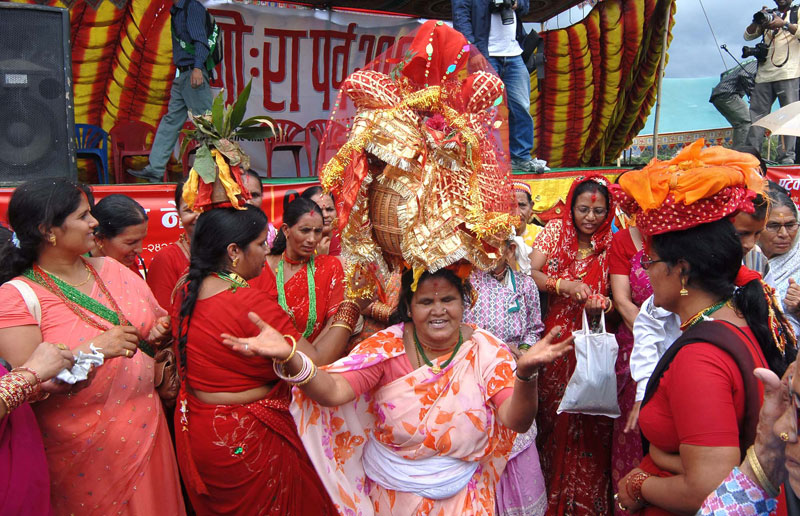
Celebrating the Shiva-Parvati love
Kathmandu
Gaura Parva, one of the festivals celebrated in the Far Western Development Region, has its own charm and vigour. This Hindu festival is not only celebrated for fun, but is also one of the identities of the area. Songs, dances and prayers are the main attractions of this festival that is more women-centric as women take fast abstaining from water, say prayers, take part in the celebrations and make merriment. However, males too involve themselves in the festival with their deuda songs and dances. The festival is primarily dedicated to Parvati and her union with Shiva. “This festival is the original and historical festival of the place. It is an identity of the Far Western Development region,” informed Nanda Krishna Joshi, Deuda Samrat, President of Deuda Samaj and member of the New National Anthem Selection Committee 2063. Not only in the Far Western Development Region, it is also celebrated in areas of Uttaranchal Pradesh of India like Kumaon and Garhwal.
The festival derives its name from Parvati. She was gori (fair) and this is why the festival adopts the name Gaura. “It is believed that she had gained this light through meditation,” added Joshi.
Story behind the celebrations
According to the Hindu mythology, Parvati was so devoted to Shiva that she wanted him to be her life partner. So, she went for a rigid fast to show her devotion towards him. She then went on a stern fast without drinking even a single drop of water during the monsoon season. She offered prayers aiming to get him as her spouse. Shiva was pleased and granted her her wish. Since then the festival has been celebrated in memory of Parvati and her devotion towards Shiva. It exemplifies the sacrifice of a woman to win the love and heart of her beloved.
If anyone has seen a lady dancing at Tundhikhel during the festival, then it is none but Sharada Devi. She is the dancer who carries the Gaura on her head and dances deuda in the Capital. “It is all fun to watch people looking at me and encouraging me. The young ones watch enthusiastically when I carry the deity on the head. It is quite difficult to carry a heavy thing on your head and dance. One needs to follow certain steps — a step ahead and a half back — using your the soles of your feet to perform the dance. Most of the people don’t know the exact steps. Some of them don’t know the hand movements while some of them can’t use their soles properly,” shared Sharada Devi.
Sharada Devi, whose original home was in Tatar, Dadeldhura learnt the steps from her aunts and sisters-in-law at the age of 16 when she was in her father’s home. She married but the passion didn’t end. She continued. She is 50 now yet she dances with all the strength and charm to celebrate the festival while stealing centre-stage at Tundhikhel. “When I am carrying the deity, another one carries Sanja (the sister deity of Gaura). It is smaller and covered in a pitambar (yellow clothing). This is all done to show the love between sister deities and a message to live happily and in cooperation.”
