








Scientists work to harness the power of the insect world
LONDON: Armies of robots are already here – they’re mostly just very small. As robotics advances, scientists continue to take cues from the natural world, whether it is by building robots out of material from animals,
like cloned rat muscle or jellyfish matter, or building them in imitation of dogs or cats. And now, those scientists are learning to simulate intelligence by imitating a swarm.
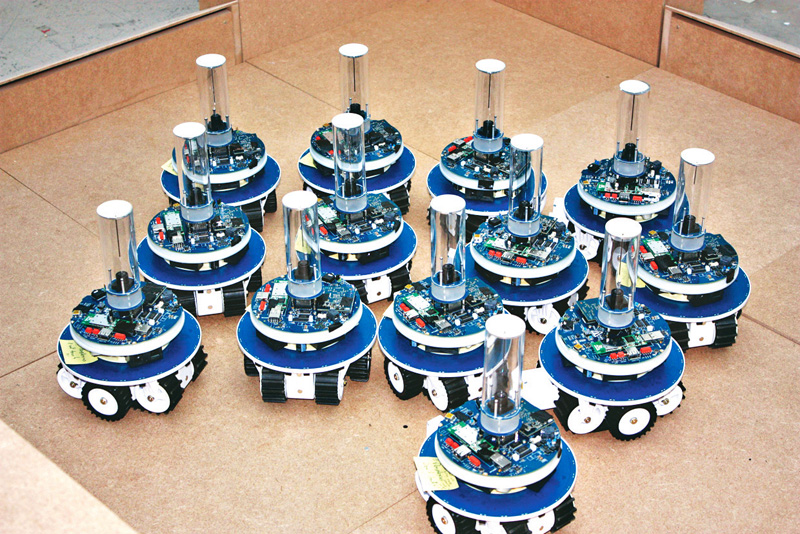
‘Swarm robotics’, beyond being one of the scariest terms outside of a Terminator film, is the name roboticists give to robots that can coordinate behaviour between multiple bodies, acting as a group.
Thomas Schmickl of the Artificial Life Laboratory at the University of Graz in Austria, points out that robots as complex as humans or even dogs are a long way off, but the possibility in the insect world for simple animals to behave in ingenious ways as a group can provide some insight into how to simulate intelligence.
Schmickl’s current crop of robots work mostly underwater – his swarm of as many as 20 swimming robots, all named Jeff, imitates a shoal of fish. With the EU-supported Collective Cognitive Robots project, he hopes to develop not just hardware but algorithms and other software to make group behaviour smarter.
In terms of bug behaviour, cyborg cockroaches have been on the open market for a few months now. Now, though, scientists are working to make flexible, durable parts from living material – recently muscle tissue from rats and even biosynthetic tissue from jellyfish have been used to make parts for robots.
Chris Atkeson, professor at the Robotics Institute at Carnegie Mellon University, said that often natural sensors are superior to what people can build, and animals’ abilities to smell, feel and hear may become a part of robotic science. One could argue, said Atkeson, that they are “analog computers in some sense”.
Atkeson points to the Ames test, in which “bacteria are used to test the mutagenic potential of chemical compounds”, in his words.
Bacteria are spread on agar with a little food and a chemical that may or may not cause mutation; when the food runs out, the only way bacteria remain is if the chemical has allowed them to mutate. “This would be an extremely complex computation to be done with computers,” he said.
