








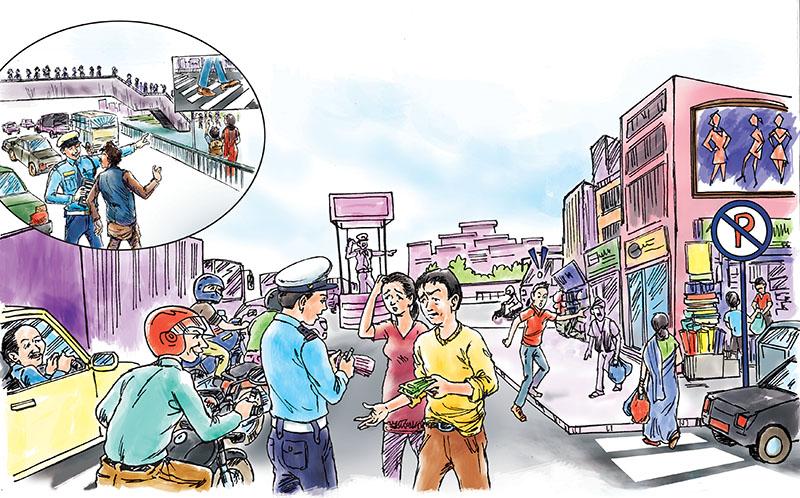
Bid to make jaywalkers toe the line
The Traffic Police are set to levy a fine and make jaywalkers attend road safety classes to ensure safer roads, but our readers feel this is not enough. Everyone should be aware of traffic rules and regulations and have a thorough knowledge, with traffic lights, zebra crossings, subways and overhead bridges in place, and most importantly working and usable
Levying a fine may be a short-term solution, but it cannot be a long-term and ideal solution to tackle pedestrian safety. Though I ride a motorcycle as a means of transport, I have travelled on public transport, and have been a pedestrian too. If you are a pedestrian in Kathmandu, you are definitely in trouble.
Footpaths are encroached on by extended shops, be it motorcycle workshops or stationery, and you will hardly find zebra crossings or traffic signals at a convenient place to cross the roads. Needless to say, there are not enough infrastructure and construction in place to ensure pedestrian safety.
This new rule might be fruitful in controlling jaywalkers who do not bother to use flyovers or zebra crossings and do not care about traffic rules despite being aware of it. But this is not the ideal solution as we have low level of awareness and willingness to follow traffic rules and regulations.
— Sandip Neupane, Balaju
I don’t think this is the best way to handle the nation’s jaywalkers. How can the government penalise jaywalkers before making sure the roads are well-maintained? Kathmandu is a city where dust and unmanaged development material rule. In the same way, due to the Melamchi Drinking Water Project constructional work, we don’t feel we are walking in the capital city of Nepal. So, before jaywalkers are penalised, the roads should be well pitched, traffic lights working, zebra crossing signals be highlighted and public awareness be carried out; then only can jaywalkers be penalised.
— Bibas jung Thapa, Hetaunda-8
Jaywalking is an irresponsible act and must be condemned. It not only puts the jaywalker at high risk of accidents, but also makes the traffic vulnerable to sudden stops, disrupting smooth flow of traffic adding tragedies to the lives of many, directly or indirectly. However, financial punishment or even short jail terms may not be efficient to restrain this old bad habit, but positive awareness campaigns could. The first target should be our future citizens and should be conducted with sincerity and enthusiasm at all primary, secondary and tertiary educational institutions nationwide to train students about the dangers of jaywalking and to be a responsible and sincere citizen of the nation. The law enforcement agencies also need proper training and awareness to control accidental offenders or to cut down corruption when an offender gets away by paying a quick bribe. A national steering committee appointed by the Parliament needs to monitor traffic violations and jaywalking offences to have credible data and determine if the law enforcement agencies are being able to enforce the anti-jaywalking laws effectively at the grassroots level. They need to report back to the Parliament on an annual basis about their findings or any progress achieved. National awareness campaigns through print and electronic media and government outlets should be developed to deal with all kinds of traffic violation rules not just jaywalking. Simply enforcing a rule in a developing nation does not work unless it is tied to socio-political framework of the nation.
— Saikat Kumar Basu
We Nepalis might be well educated, but are yet to be civilised. We seldom voluntarily obey rules and regulations unless someone forces us to do so. There are overhead bridges and sub-ways to cross the roads, but I have seen people crossing the roads randomly even in the busiest sections like in Sundhara and Ratnapark. We have the mentality of ‘who cares’. Who cares why these overhead bridges are built? Who cares about using them when I can just cross the road from here? Who cares about the struggle of traffic police to manage traffic? Therefore, in my view, it is a good decision to penalise jaywalkers. I believe this move will reduce the number of jaywalkers and accidents significantly.
— Nabin Kadariya, Pipal Chowk, Gaighat
Traffic rules should be strictly followed to help reduce road hazards. Every life is precious and should not be wasted or paralysed by violating any rule. Attending road safety classes and fine of Rs 200 can help make people aware about importance of following traffic rules, but it is not the ideal solution. Unless jaywalkers realise their responsibility regarding following rules, the outcome will be zero. I am sure executing new rule is not difficult for us now since we all have succeeded in making Valley a horn-free city, which is praiseworthy.
— Shradha Neupane, Mahankal
The traffic volume of Kathmandu Valley has been increasing day by day. So, it has become a serious problem to control traffic. And sometimes pedestrians are so reckless. But there are problems with the road signs as well. I have seen that in many places there are both overhead bridge and zebra crossing at the same place while one hoarding board is facing us and saying ‘Please always use zebra crossing’. People get confused; what should they use — overhead bridge or zebra crossing? Kathmandu Valley’s Traffic Police are implementing new rules every year to penalise and earn money, but they never try to curb the problem — their main intention is to make money, rather than eliminate the problem.
I have volunteered for traffic work at Baneshwore and Koteshwore for around four months. I think to control jaywalkers, they should make new rules such as giving incentives rather than levying a fine, no matter how big or small. Sometimes if you don’t have money and time, what would be the solution — different kinds of people live here. We appreciate the gesture but berating is not the solution. And what about the traffic personnel who are rebuking a person harshly — what is the penalty for them?
— Nabin Joshi
I think that the Traffic Police is doing a wise job by setting a fine and road safety classrooms for jaywalkers because when a person gets fined, then s/he realises his/her mistakes through which they become aware each time they are riding or walking. When s/he goes to attend such a class, s/he will become more aware. When they are fined, they start telling their experience to their mates through which others will also be aware about following traffic rules. Hence, I support what the Traffic Police is going to do, and I think it is an important base for the nation’s development too.
— Tulip Gyawali, Kathmandu
Vehicular congestion and jaywalking have caused a mess in traffic management in the country. Pedestrians disregard traffic rules and cross the roads haphazardly sending traffic management in disarray. Although the penalty was only effective for motorists, implementing a plan for making it effective for jaywalkers will help curb jaywalking. The new plan is indeed an ideal plan for the time being to discourage jaywalking as paying a penalty or attending a class for Nepali people is fractious.
— Geeta Lamichhane
There are thousands of traffic rules for motorists and if they happen to make a simple mistake, they are highly penalised; but pedestrians, who never happen to follow a single rule, never face any ire. The government is going to fine jaywalkers Rs 200 for breaking a rule. If we observe it from one side, it is a good move; but from another point of view, rich people can certainly pay that fine but people who hardly earn Rs 200-300 per day may have a problem. Another thing is that keeping Traffic Police in every place is not possible. In places with Traffic Police, rules may be followed; but there are chances of the rules not being followed in other places.
Rules are certainly made to be broken. So instead of wasting money and time in such a thing, we must be have compulsory safety educational classes, and we must make and use traffic lights, zebra crossings, overhead bridges, et cetera at different places. And Traffic Police must only be stationed in accident-prone areas. Although fine collection may not be the best way, but penalising people who are responsible for accidents would be the best instead of always penalising motorists.
— Safal Subedi, Pokhara
It seems that our Traffic Police are trying their best to minimise road accidents. However, I do not think this is the best way. Due to heavy monetary penalty to be paid by motorists who break the traffic rules, they nowadays follow the rules seriously, whereas pedestrians are not charged. If the jaywalkers are charged only Rs 200 at a time, it seems the police are underestimating the poor and supporting the wealthy. Wealthy people may pay that meagre fine, but what about those who are so poor, who instead of going by bus prefer to walk? In how many places will Traffic Police fine people who violate rules? Also there is no certainty that the person who pays the fine will not violate the rules again. Only fining people does not solve the problem. Therefore, if there are traffic signals in every main square or roundabout, then everyone has to follow it.
— Deepshikha Gurung, Pokhara
Most of the Nepali people are not educated. This is also the one of the reasons why many traffic rules are not being followed. The pedestrians don’t have proper knowledge about traffic rules, so they violate it while crossing roads. Now jaywalkers are going to be fined for breaking traffic rules. As a citizen of this country, I don’t think this is the best solution for the problem. It means that those who are rich, they can break the rule, pay the small amount of fine, and escape the problem. But what about the poor? This is not the proper solution for all. First of all, the government should provide knowledge and conduct awareness programmes about traffic rules so that people are aware — I can guarantee that this can solve the problem seen in pedestrians.
— Shiva Paudel, Pokhara
Pedestrians also violate traffic rules, not only motorists. Now the government has planned to fine jaywalkers, which I think won’t have a good outcome because people here lack knowledge on traffic lights, zebra crossing, and traffic rules. Putting traffic lights in required areas would solve some of the problems. I don’t think charging Rs 200 for jaywalking is the best idea to reduce the chances of road accidents. Some pedestrians are ready to pay the fine but they will violet the rules again while rushing on in their busy life. Instead of charging Rs 200, they can catch the violator and give them motivational teaching so that from next time they won’t be violating rules.
— Asmit Gorkhali
I think fining Rs 200 and attending a traffic rules class is a good thing because that way we will learn to follow traffic rules. We will learn that we should cross the roads at zebra crossings. When we walk we should always follow traffic rules. Otherwise, we have to face this trouble. People will change their behaviour to avoid trouble.
— Mini Tamang
It is said that something is better than none. Something had to be done about the jaywalkers problem. As a rider myself, I find the habit of reckless pedestrians a big problem. People just cross wherever they want. The worst case is when they haphazardly walk from the front of the vehicles and the sides and they even run across the roads. I have to slow my scooty whenever a micro stops on the side and check who is crossing the road fearing that someone will run in front of my vehicle when I am about to speed up. Some people cross roads while talking on phone or chatting with their friends. And now we cannot even blow horns!
Recently, I shouted at a girl when she was crossing the lane without even looking back. I think the roads accidents will be prevented if people become aware of their own lives, and of others too. The commendable rule of ‘No Horn’ has made people aware of the unwanted traffic noise. As the saying goes, a clap is not formed by only one hand, it’s time to make pedestrians realise the importance of road safety. I believe the new rule of penalising jaywalkers will make road traffic safer for both. Every new effort should be encouraged.
— Nisha Shrestha
I think it is an ideal solution to charge a fine or make jaywalkers attend a road safety class. People knowingly or unknowingly break traffic rules. Generally when people are in a hurry, they are more likely to break traffic rules. In the same way, people from remote areas cross the roads running. They even don’t know what zebra crossing is and why they are on the roads. To make them aware about the traffic signs and rules, attending a class about traffic rules is necessary. I appreciate the current effort and steps of the Traffic Police to curb accidents. This rule not only raises the level of awareness about road safety but also ensures the development phase in area of road transportation. I think this rule should be applied in every city of Nepal so that people will be more practical regarding traffic rules.
— Prem Chaudhary, Kirtipur
The Traffic Police in Nepal are about to do a good job because jaywalkers are the ones who need to be taught the rules related to traffic as soon as possible. They are also the ones who are risking their own lives. Jaywalking has been seen as a reason that increases road accidents in a country like Nepal where traffic jams have remained a serious problem. Those found guilty of violating traffic rules by jaywalking should be held and sent strictly to a road safety class no matter whoever they are. Hence, I support the initiative being taken by the Metropolitan Traffic Police of Nepal when it comes to maintaining road safety.
— Pratik Shrestha, Buddhanagar, Baneshwore
Pedestrians should be penalised for violating and ignoring traffic rules in the Valley, like the motorists. Setting a fine of Rs 200 or making them attend road safety classes are not the ideal way of solving this issue. Other steps should also be put in place by the government to handle our nation’s jaywalkers.
— Amet Pandit
I don’t think penalising the jaywalkers and giving road safety classes to those who don’t have money is the ideal solution to handle jaywalkers. Paying the fine maybe the easiest way to escape, but for some people it will be very difficult. Most people have seen almost all motorists being penalised but the motorists also don’t obey traffic rules. It will be the same for jaywalkers. Instead of levying any sort of fine, each and every jaywalker should be taken to a motivation class related to traffic rules as well as road safety. If they become a repeat offender, then more than
Rs 1,000 should be levied as fine. Making the jaywalkers attend road safety classes can kill their time, but after doing this they will learn something that will save them from accident. It will be beneficial if there are well marked zebra crossings and traffic lights instead of Traffic Police. A thorough knowledge of traffic rules/regulations, traffic signs and markings would be essential for drivers and pedestrians. The proper knowledge of these rules will not only reduce the number of accidents but will also establish a healthy traffic system.
— Prerana Gurung, Pokhara
