





Google unveils quantum computer breakthrough; critics say wait a qubit
- Able to crack random number problem in minutes
- Breakthrough compared to first manned flight
- IBM : Google hypes achievement, risks misleading public
BERLIN/SAN FRANCISCO: Alphabet Inc's Google said on Wednesday it had achieved a breakthrough in computing research by using a quantum computer to solve in minutes a complex problem that would take today's most powerful supercomputer thousands of years to crack.
For decades, computer scientists have sought to harness quantum physics, laws governing the behavior of particles that are smaller than atoms and can simultaneously exist in different states.
Quantum bits, or qubits, can be set to one and zero at the same time, unlike today's computer bits that are either ones or zeros. This superposition property multiplies exponentially as qubits become entangled with each other, meaning the more qubits connected, the vastly more powerful a quantum computer becomes.
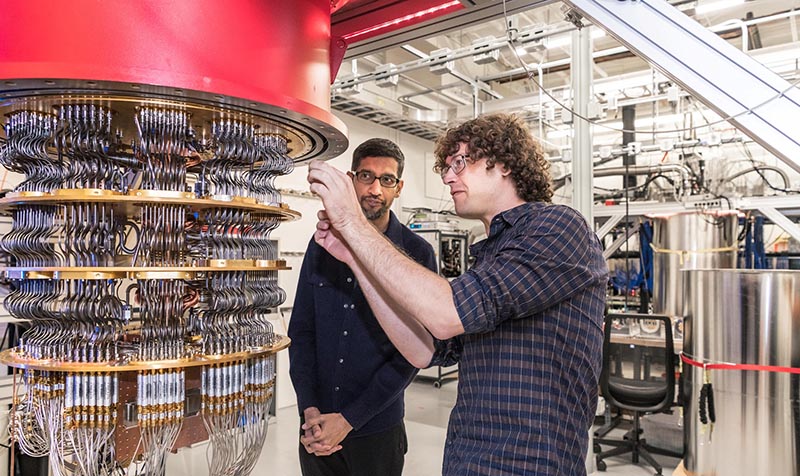
But there is a catch: Quantum researchers need to cool qubits to about absolute zero (-273 degrees Celsius or -460 degrees Fahrenheit) to limit vibration - or "noise" - that causes errors in calculations. It is in this challenging task that Google, which has designed much of its own electronics and used liquid helium for cooling, has made significant progress.
CEO Sundar Pichai compared the achievement to building the first rocket to leave Earth's atmosphere and touch the edge of space, an advance that brought interplanetary travel into the realm of the possible.
"For those of us working in science and technology, it's the 'hello world' moment we've been waiting for - the most meaningful milestone to date in the quest to make quantum computing a reality," Pichai wrote in a blog https://blog.google/perspectives/sundar-pichai/what-our-quantum-computing-milestone-means.
Sycamore, measuring about 10 mm (0.39 inch) across, is made using aluminum and indium parts sandwiched between two silicon wafers. In their experiment this year, the researchers were able to get 53 of Sycamore's qubits to interact in a quantum state.
They then had the quantum computer detect patterns in a series of seemingly random numbers, and it succeeded in 3 minutes and 20 seconds. They estimated that the same problem would take 10,000 years for a Summit supercomputer - the most powerful in the world today - to solve.
Hold on a qubit
While the peer-reviewed research has drawn plaudits, with MIT's William D. Oliver comparing it to the Wright brothers' first flights, skeptics say Google is over-selling its achievement.
IBM said a supercomputer with additional disk storage can solve the random number problem in at most 2-1/2 days and with greater accuracy. It also said Google risked misleading the public by implying the new-style computers would replace existing ones.
"Quantum computers will never reign 'supreme' over classical computers, but will rather work in concert with them, since each have their unique strengths," Dario Gil, director of research at IBM, wrote in a blog https://www.ibm.com/blogs/research/2019/10/on-quantum-supremacy.
Torsten Siebert, manager of the quantum computing research program at Germany's Fraunhofer Society, agreed that "progress was likely to be achieved through such hybrid combinations."
Researchers also have expressed concern about quantum computers being used, for example, to unseal secure data and passwords or enable new forms of surveillance.
But before quantum computers can break codes, security experts have plenty of time to adapt, Martinis said.
"We're pretty confident we'll all stay safe and secure in the future," he said.
