





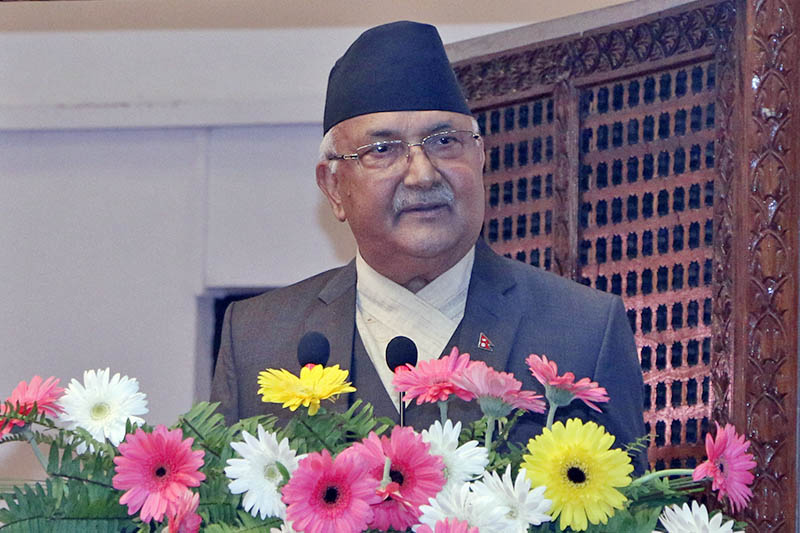
BRI vital for promoting connectivity: PM
Kathmandu, September 12
Prime Minister KP Sharma Oli today said that the Belt and Road Initiative launched in 2013 by Chinese President Xi Jinping, was an important step that aimed to promote connectivity and cooperation among countries in the region and beyond.
He said this in his inaugural address at the international conference on ‘Belt and Road Initiative: opportunities and Implications for Nepal and the region’ organised by the Master’s Programme in International Relations and Diplomacy, Tribhuvan University today.
According to a press release issued by the Ministry of Foreign Affairs, the PM said the transformative scale and scope of this initiative had opened up a plethora of opportunities to integrate the economies, to connect markets and to invest in infrastructure.
“As President Xi has outlined, BRI lays out a mutually beneficial framework to build a community of common interest and community of common destiny,” the PM added.
The PM said BRI could serve as an important catalyst to realise Nepal’s development agenda and prosperity goal.
“We believe that BRI can support countries like Nepal to grow and prosper at a greater speed by ensuring equitable benefits to us,” he added.
As a framework to spur investment and enhance connectivity, BRI can be instrumental in addressing our development bottlenecks; in mobilising finance for our development needs and ensuring win-win cooperation, the PM said.
While the resource gap looms large at the global level, the PM said, BRI can also be instrumental in implementing Sustainable Development Goals. “This way, it will serve the global good in the interest of humanity,” he added.
He said while increasing protectionist tendencies were eroding the rule-based multilateral trading system, BRI could be an option for openness and shared benefits.
“While the locus of economic development shifts to Asia, BRI can be an engine for a new wave of globalisation. Globalisation which is inclusive; globalisation which is just; and globalisation which is humane,” the PM said.
The PM said Nepal and China had committed to enhance connectivity encompassing vital components including ports, roads, railways, aviation and communications within the overarching framework of trans-Himalayan multi-dimensional connectivity network.
The PM said the recently finalised text of Protocol to Agreement on Transit Transport between Nepal and China would provide Nepal access to all the Chinese sea ports.
“This is an important milestone towards Nepal’s transformation from a landlocked to a land-linked country,” he said.
Our two countries have started discussions on various BRI related projects.
The PM said regional organisations such as SAARC and BIMSTEC were also important platforms for multidimensional regional connectivity. “We must make these regional organisations fully functional and result-oriented,” he said.
The PM said the government would be solely guided by national interest in selecting or accepting projects and programmes under any bilateral, regional or multilateral mechanisms.
“We will not be swayed by any opinion or view that is not objective and grounded on realities,” he added.
The PM said that following the consolidation of political transformation of historic proportions, Nepal was now at an important juncture of undertaking socio-economic transformation.
“We believe that unprecedented economic transformation taking place in China and India offers huge opportunities for Nepal,” he said, “As a country situated between the two economic powers, Nepal cannot remain forever in the lower rung of the development ladder. We must climb the ladder, and climb at a faster pace.”