








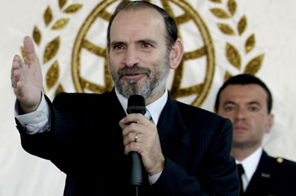
Peru's prime minister to resign
LIMA: Peru's Prime Minister Yehude Simon said he will resign in the coming weeks once a crisis over Indian rights in the Amazon has been settled and calm returns.
"I will leave as soon as everything has been calmed down, which should be in the coming weeks," he told the privately owned Lima radio station RPP.
Simon has been at the forefront of a confrontation between the state and indigenous leaders over government plans to open the Amazon to development, which erupted in violent clashes earlier this month, leaving at least 34 dead.
The prime minister said he would speak Wednesday with President Alan Garcia, who will have "enough time to decide what he has to do."
For his part, Garcia made no public comment Tuesday on the resignation announcement by his top aide, although he said he supported Simon's decision Monday to seek repeal by Congress of the unpopular decrees that would have allowed mining and other economic development in the Amazon rain forest.
"We have to open up a space for reconciliation, peace and hope in our nation," Garcia said, adding that the concession was necessary not only for the country's political welfare, but to ensure its economic development in a climate of "peace and tranquility."
"No one makes investments where there is a feeling (that the society is) out of control," he said.
But Garcia added that a government remains committed as a frontline goal to Peru's economic advancement, saying that his government must be able to determine "which goals not to retreat from -- and we are not going to retreat from development."
Simon's action came a day after a dramatic reversal in policy by the government, which had come under pressure from the opposition and international reaction to the bloody crackdown.
The prime minister traveled on Monday to the eastern Amazon basin and personally announced to the traditional Indian chiefs that the government would seek the repeal of the unpopular decrees that touched off the crisis.
Indian leaders, angry that they were not consulted, launched a strike in April in opposition to measures they said would threaten their way of life by opening the Amazon rainforest to foreign oil and mining companies and other commercial interests.
The strike erupted into bloody clashes June 5 to 6 after police were sent into clear roads of Indian-manned blockades around the city of Bagua, 1000 kilometers (600 miles) north of Lima.
In the radio interview, Simon defended the government's decision to yield to the Indians demands.
"The government has to know how to listen," he said. "We have done the right thing. If the cabinet has to take a step back, we will take a hundred steps back of the country."
He said a bill scrapping the decrees would be introduced in the parliament on Wednesday.
There were signs that tensions were easing on the strike-hit roads and riverways of northeastern Peru, and an important east-west highway reopened on Monday.
The opposition, the Peruvian press, as well as the main Indian collective had demanded Simon's resignation, but he had said he would not leave under pressure.
But on Monday, he raised the possibility he might step down, saying he would have no problem doing so once the crisis with the Indians was resolved.
He appeared to have been shaken by the deaths of police officers and Indians in the violence 10 days ago, saying their deaths would stay with him "until death."
Simon, 61, a leftist who describes himself as a "humanist," was named prime minister in October 2008 to give a "social face" to president Alan Garcia's liberal economic policies.
